

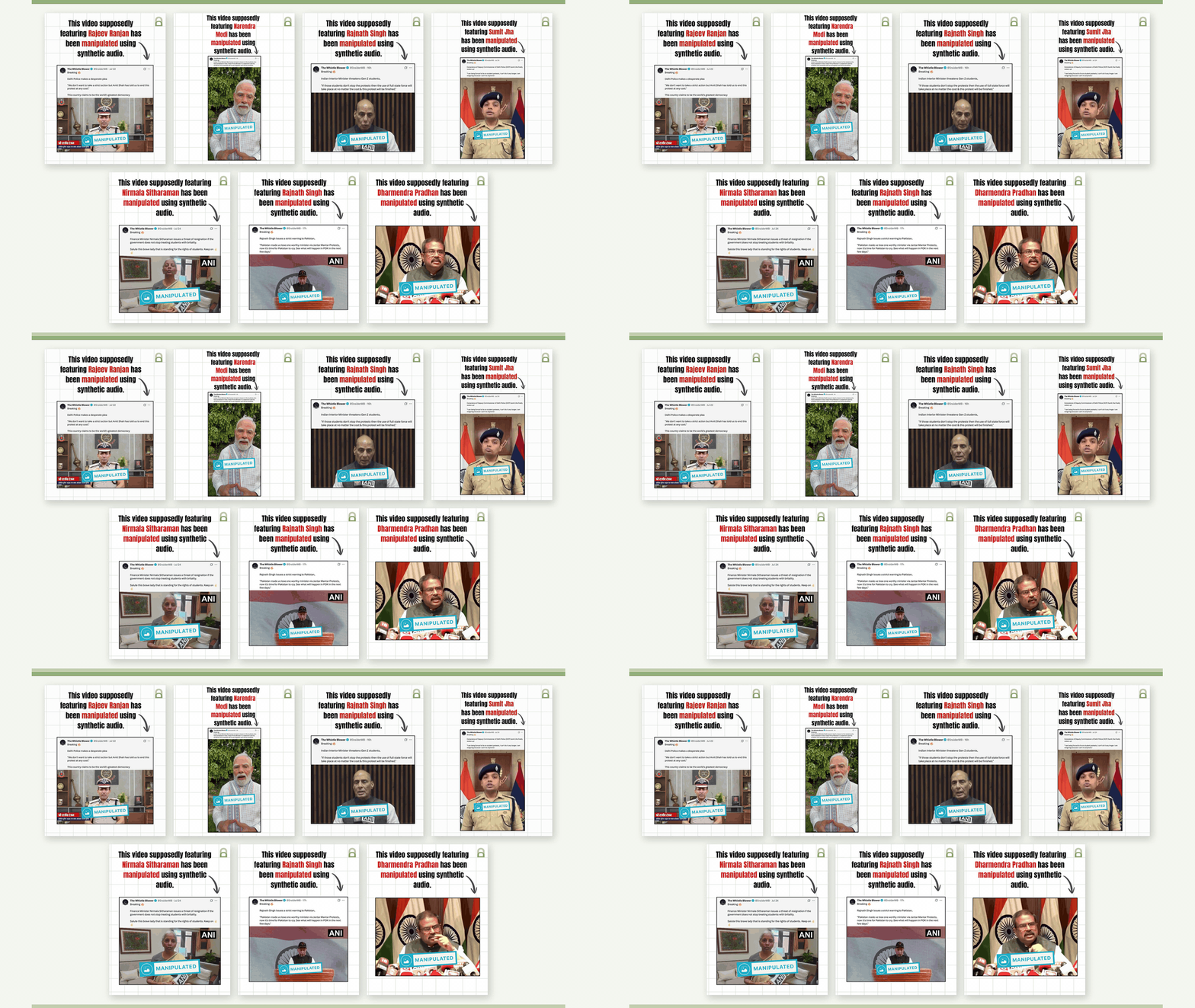
In July, the world watched as tens of thousands of disgruntled Indian students took to the streets in an agitation spearheaded by the self-described Cockroach Janata Party (C.J.P.). But, few were watching a parallel, insidious fabricated narrative of India’s top ministers and senior police officials reacting to the protests when, in reality, they were not.
The videos looked convincing. Some seemed like clips from press briefings, others resembled public addresses, and then there were supposed interviews too. But, the voice in each of the videos was synthetic or A.I.-generated. If any of those videos hit your social media feed there is every chance that you'd have taken them for real.
As the Deepfakes Analysis Unit (DAU) was tracking and debunking this content, the timeline of one account on X, formerly Twitter, was flooded with these videos. That particular account has been withheld in India in response to a legal demand, however, we were able to access it through a VPN or virtual private network. We do not know whether these videos originated from that one account or another or across other platforms.
The methodology used by bad actors behind the videos isn’t new, it is practised, and is only getting better with the availability of new A.I. tools. It involves stealing real footage and stitching it together with fake audio to confuse, mislead, and even cause real-world harm. It is clear that people living outside India had and likely still have access to those fabricated videos.
Shared below are our observations and analysis from seven videos that were the most high-profile among the several we analysed and debunked. Our endeavour, as always, is not to give more oxygen to bad actors. We want to give you a sense of how the narratives were manufactured; what were the common strands; and what we observed during our analysis, including how A.I. detection tools were able to assess some manipulations and where manual analysis helped.
Fabricated threat
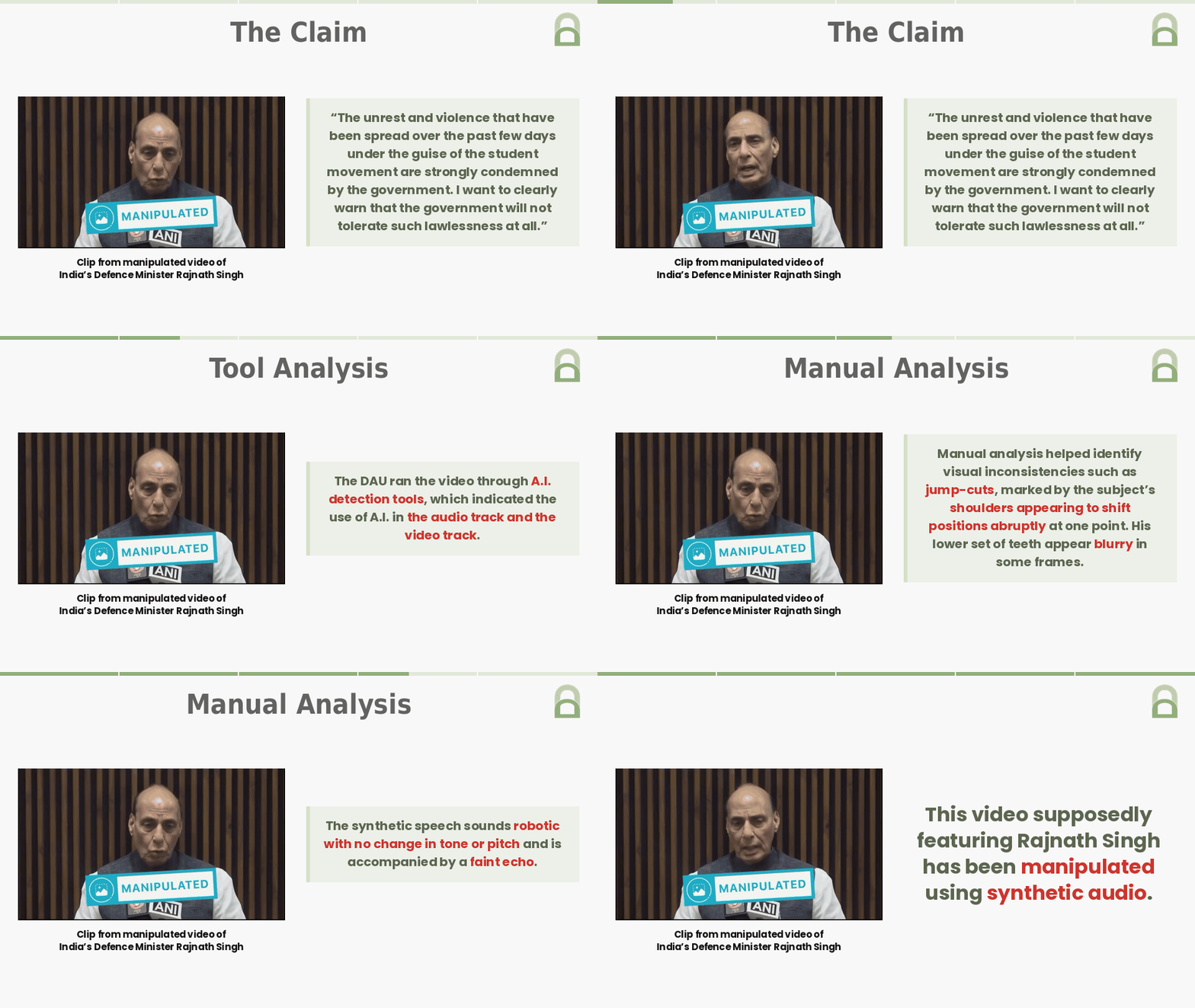
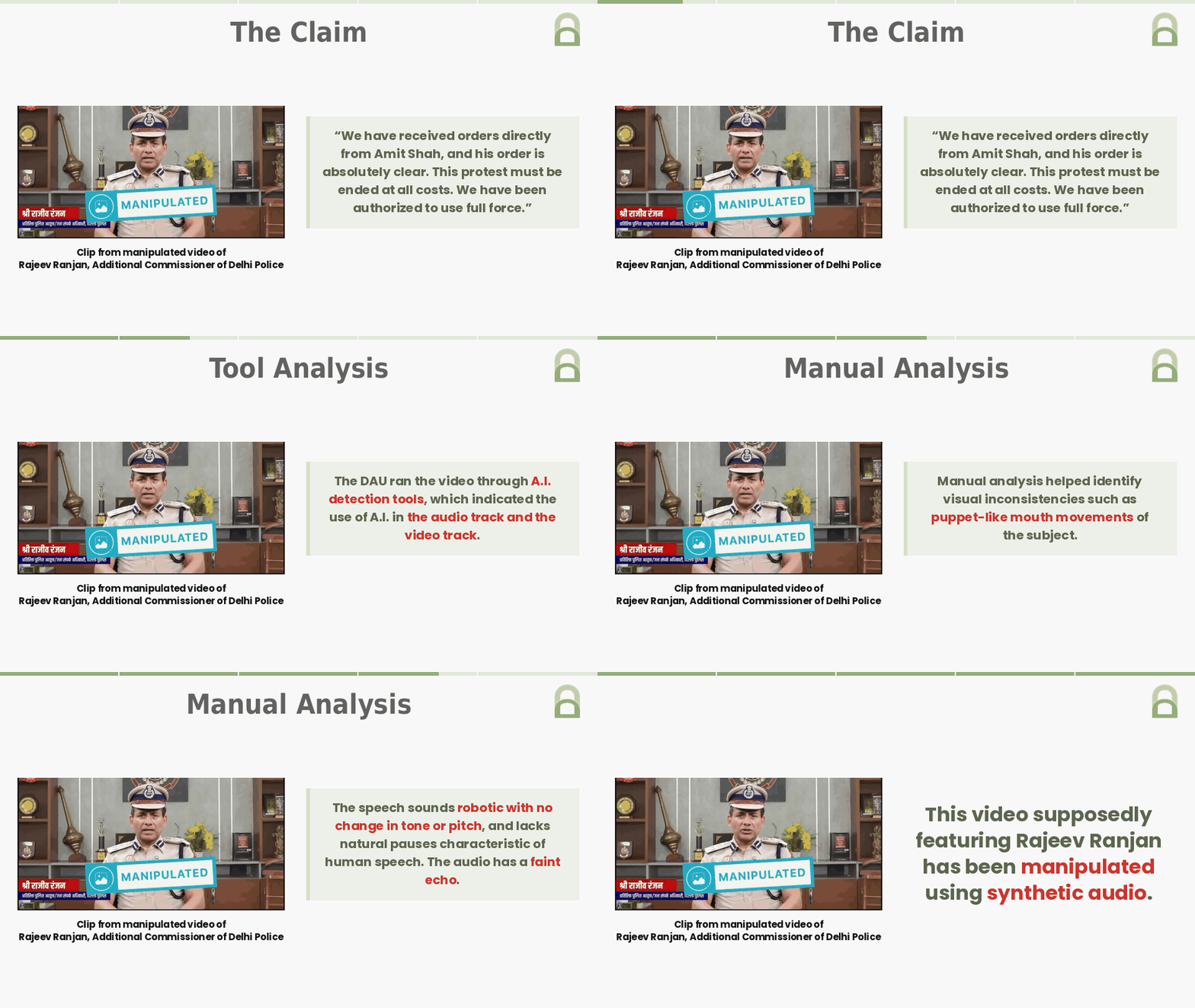
Three of the seven videos we analysed threatened strict action against the protesting students. From warning that a lesson would be taught, to more explicit expression of intimidation through the potential use of brute force by the government, the synthetic voices said it all while the faces behind them never used those words.
And how do we know that? We traced the source footage for each video using reverse image search and compared the original videos with the doctored versions. We then ran the videos through A.I. detection tools to conclude that the videos were A.I. manipulated.
Resignations and manufactured empathy
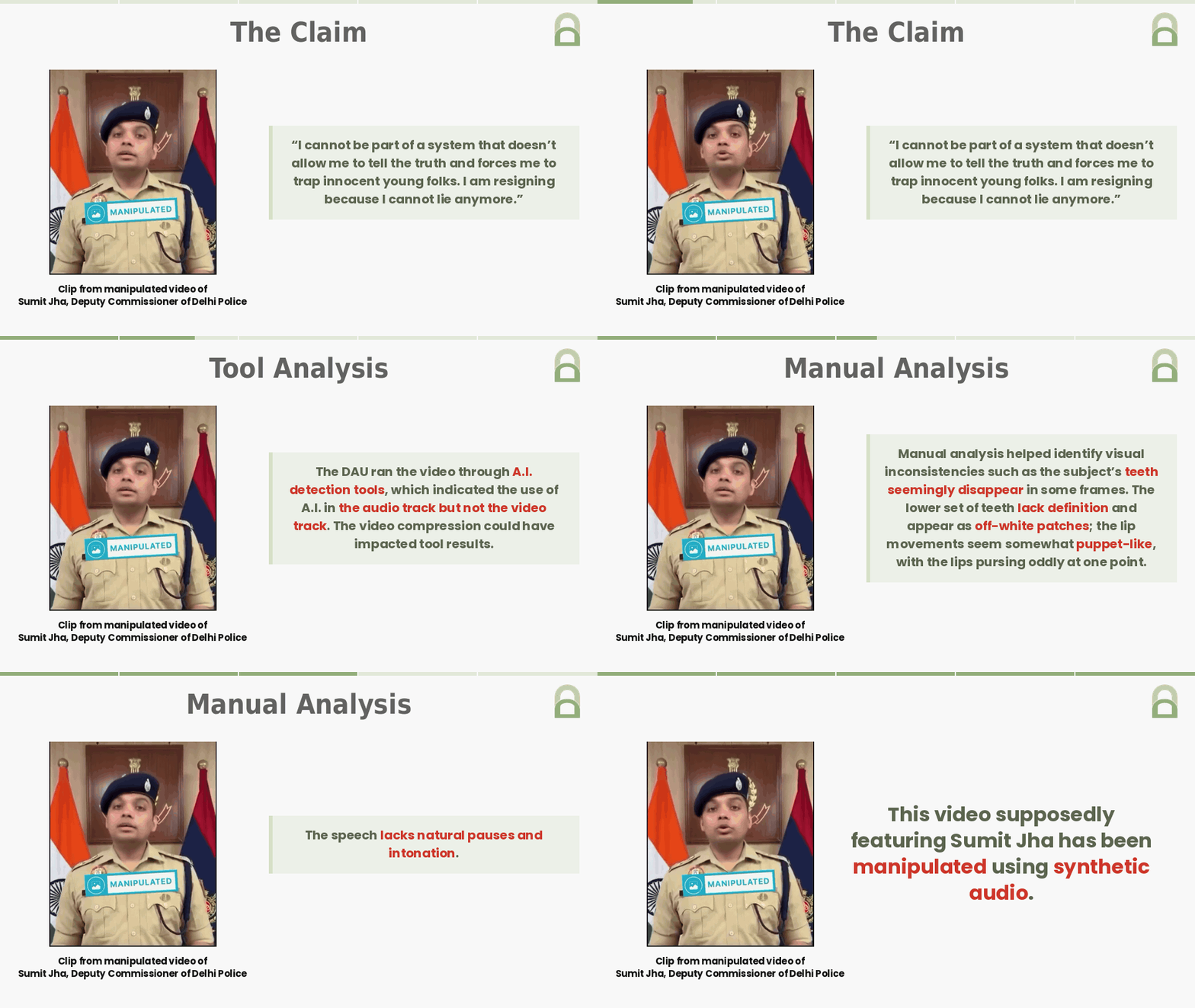
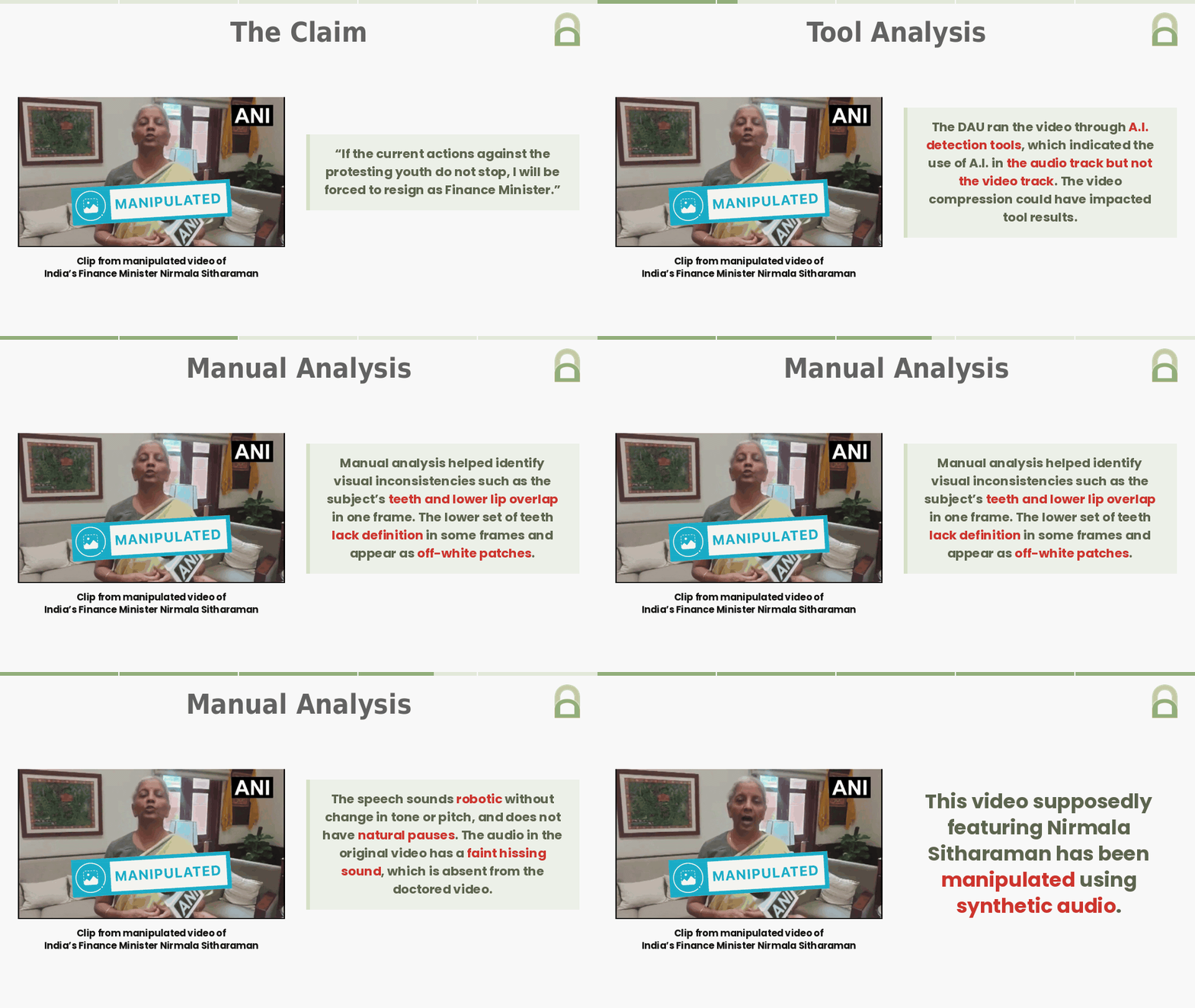
While the A.I.-generated threats loomed on the one hand, support for the dissenting students was conjured by generative A.I. tools too! A senior police officer seemingly offered to tender his resignation while expressing dismay over the government’s handling of the student protestors. And the same narrative, though in more scathing words, was heard in a video that seemingly featured India’s Finance Minister Nirmala Sitharaman.
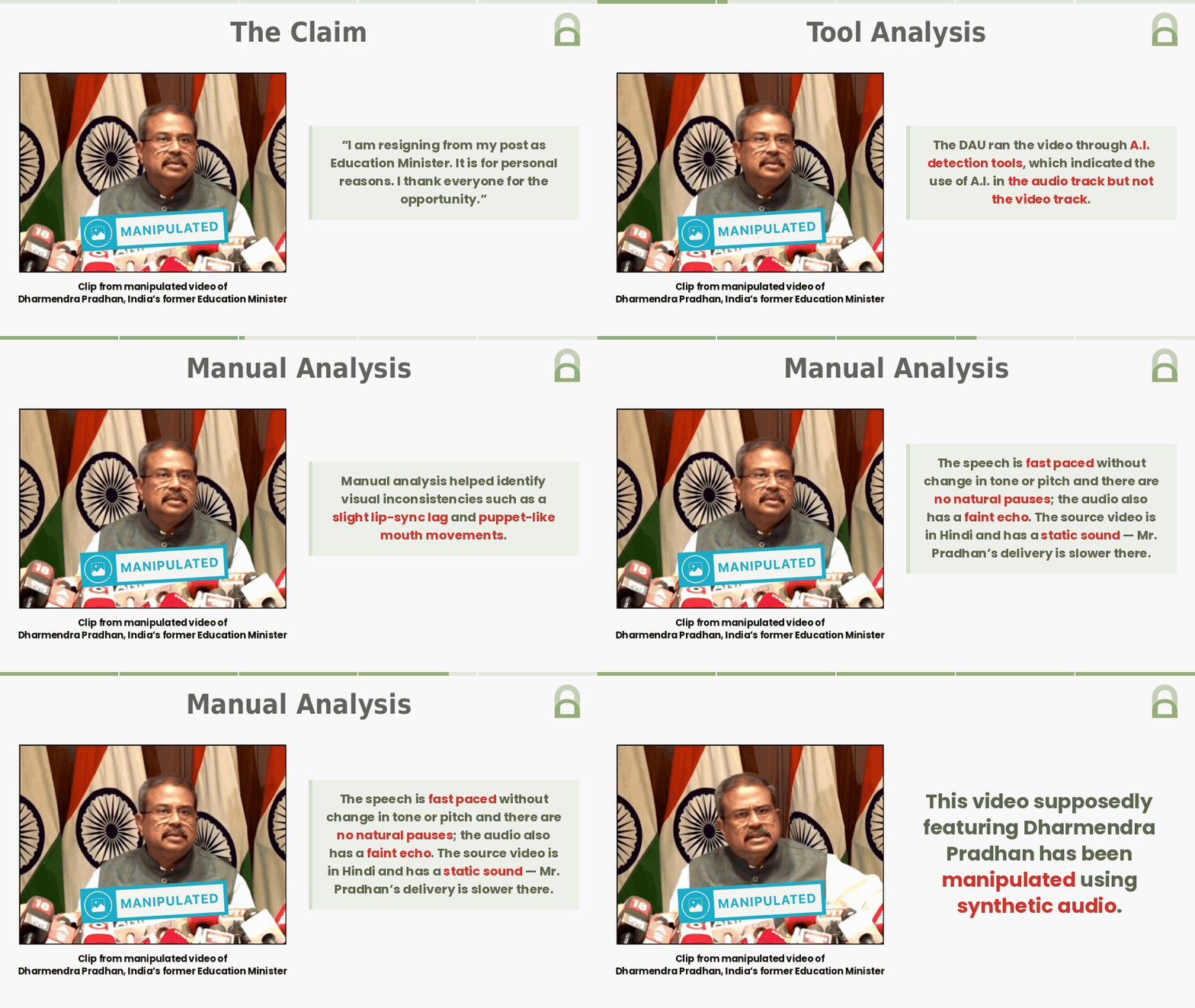
One of the videos also appeared to show that Dharmendra Pradhan resigned as India’s Education Minister under the glare of cameras, citing personal reasons. Mr. Pradhan did resign on July 25, 2026 but he did not announce it at any media briefing or press conference, as the doctored video made it seem.
The Pakistan angle
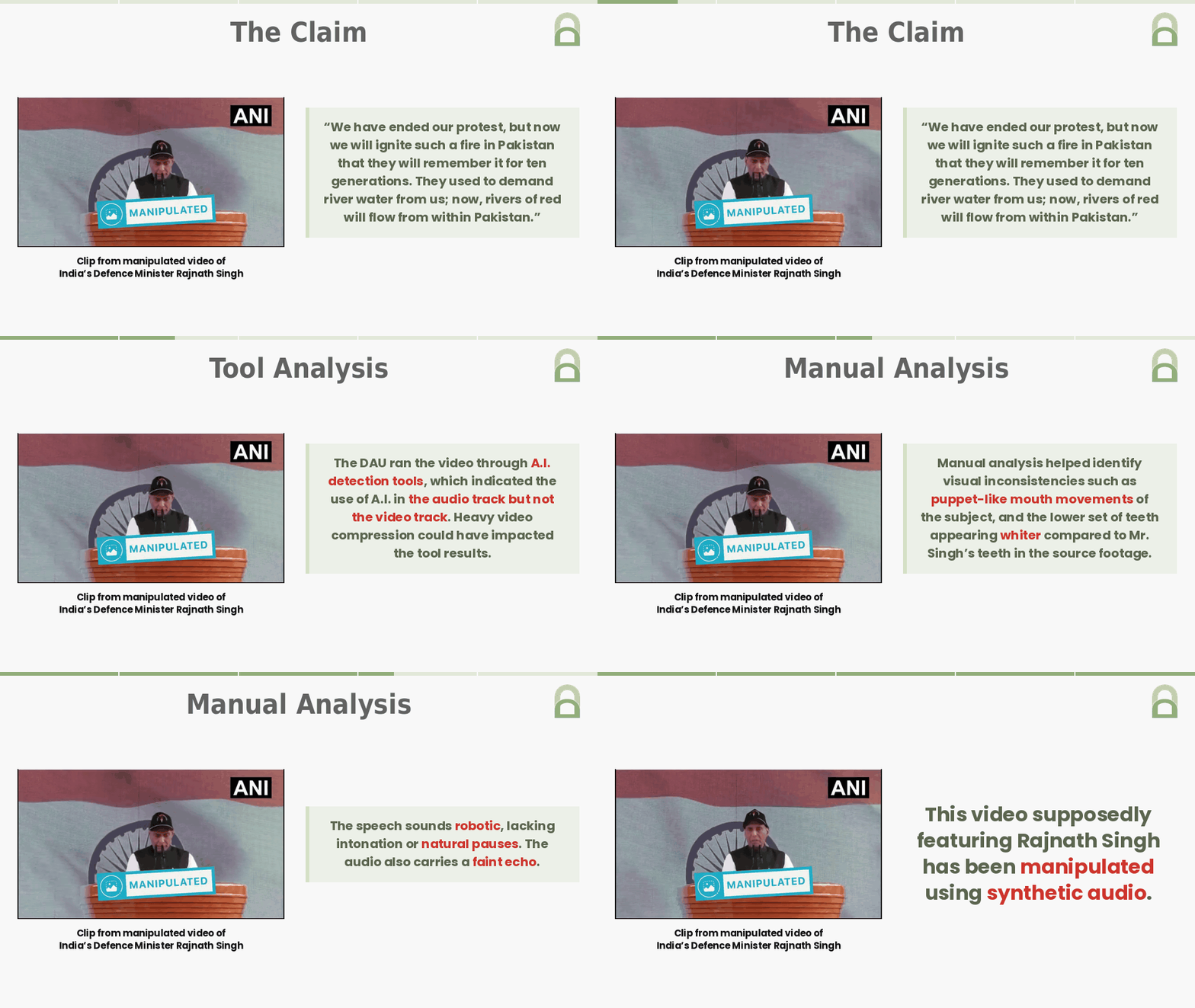
India’s Defence Minister Rajnath Singh was targeted through more than one video. The tone of the second video we analysed was more virulent than the first. The threat this time was directed at Pakistan and not the students. The synthetic speech conveyed that revenge would be sought in Pakistan-Occupied Kashmir in retaliation for protests in India and Mr. Pradhan’s resignation.
What A.I. detection tools didn’t tell
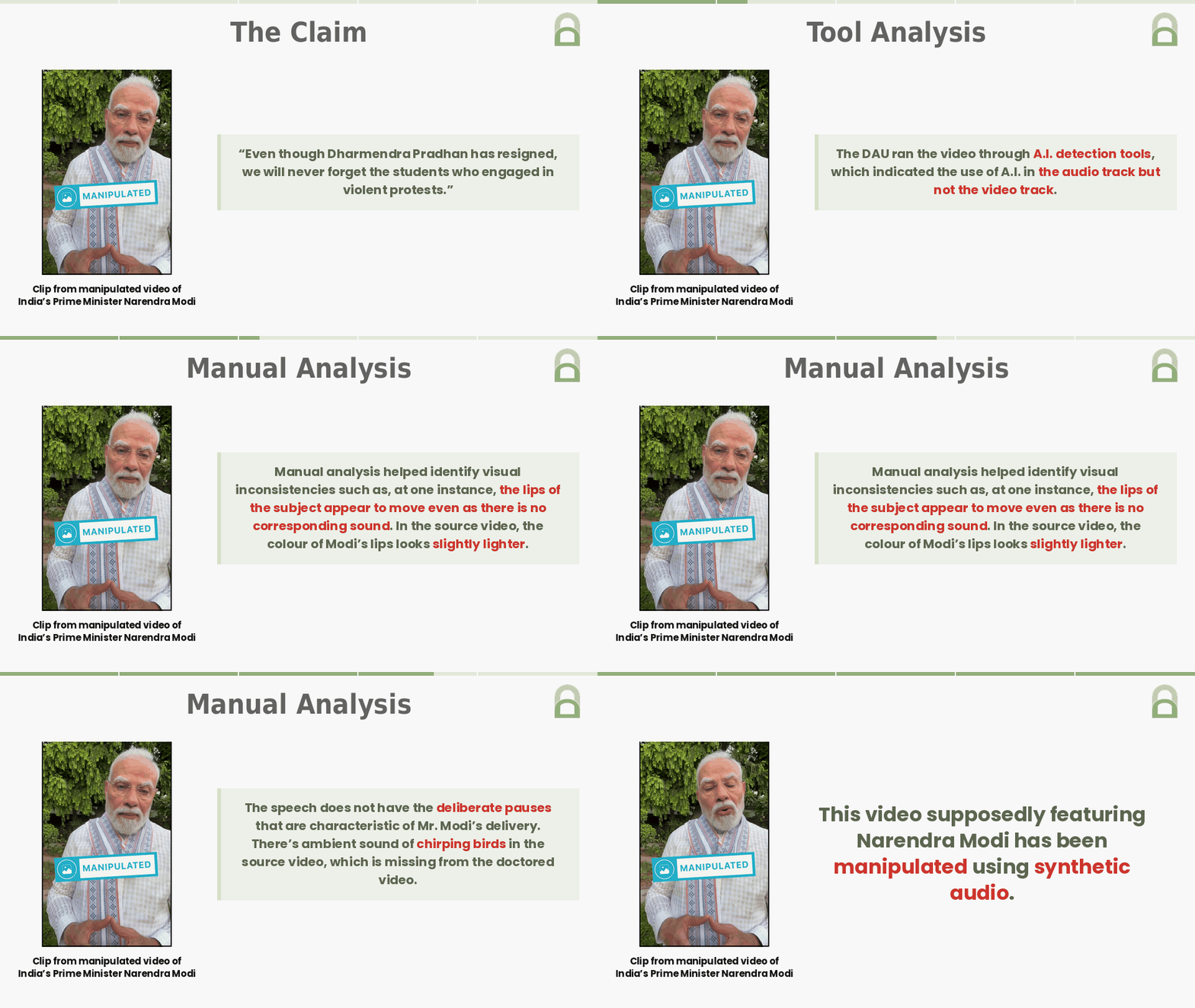
The audio in the source video and the manipulated version was not necessarily in the same language. The duration of the clips was short, the messaging was terse, and in some cases the voice sounded very similar to the person whose face was used as a guise.
Puppet-like mouth movements or lips moving without corresponding audio at specific instances were signs that we didn’t ignore. The ambient sound or static noise missing from the doctored version of the video or that faint echo added to the synthetic audio track, were minute yet important details that we picked up on.
The teeth are almost always a tell. In each video, the teeth of the subject either changed shape or disappeared between frames. In some cases, they appeared like off-white patches or the lower set looked blurry. The teeth also overlapped with the lower-lip in one video, in another they appeared more polished and white than the subject’s teeth in the source footage.
The visible body language matters too. We noticed a jerky shoulder in one video that also had jump cuts. That exact body movement could not be traced to the source video, which was seamless. The doctored version was likely stitched up using shorter clips from the source video, which resulted in that odd shoulder movement.
There’s also a scenario when that exact body movement from a doctored video, which has no cuts or transitions, cannot be traced to a source video. For example, a subject seems to position his hands on a podium in the doctored version when the same gesture cannot be traced to the source video. It makes one wonder whether the video is fully A.I.-generated but what explains the similarity to the source video?
None of the seven videos analysed in this post exhibited that exact scenario, however, it's a recent trend that we are noticing with short manipulated videos. We reached out to our partners at RIT’s DeFake Project to understand what might be happening. They explained that models use the input video and multiple reference frames to establish the context of a scene and then modify the actions or characters.
So until next time, pay attention to every little detail and don’t fall for “invented” realities!
(Edited by Pamposh Raina.)
Kindly Note: The manipulated audio/video files escalated to us for analysis are not embedded here because we do not intend to contribute to their virality.
If you are an IFCN signatory and would like for us to verify harmful or misleading audio and video content that you suspect is A.I.-generated or manipulated using A.I., send it our way for analysis using this form.


